
During spring term 2026, University of Oregon students connected with their local community to develop career-focused transferrable skills.
Through the Sustainable City Year Program (SCYP), more than 60 students partnered with the City of Eugene, Eugene Area Chamber of Commerce, and Downtown Eugene Merchants to tackle real-world challenges related to transportation, public space, and downtown revitalization. Across three different disciplines, students conducted research, engaged with community members, collaborated with professional staff, and developed recommendations that will help inform future planning and decision-making.
The projects also align with the Oregon Rising strategic plan, which emphasizes preparing students for successful careers through hands-on, experiential learning. Students gained opportunities to apply classroom knowledge in professional settings while building career-ready skills. These experiences help prepare graduates to navigate complex challenges and contribute meaningfully to their future careers and communities.
While each class addressed a different aspect of downtown, students shared a common experience: seeing firsthand how classroom learning can create profound community impact.
Seeing Eugene Through a New Lens
For many students, the partnership changed how they viewed the City they call home during their time at the University of Oregon.
"Working on the project has made me more aware of everything downtown has to offer," reflected University of Oregon student Dana Cowley. "Being a student, it's so easy to get caught up in the university, and UO and Eugene become interchangeable in your head. Being able to take a step back and intentionally learn about and visit downtown has instilled a new sense of pride in this City in me."
That deeper connection to the community became a common theme across all three classes.
Building a More Vibrant Downtown Through Public Relations
Students in the Public Relations Campaigns (J COM 472) class partnered with the Eugene Area Chamber of Commerce and Downtown Eugene Merchants to answer an important question: How can downtown Eugene attract more visitors while improving public perceptions of safety?
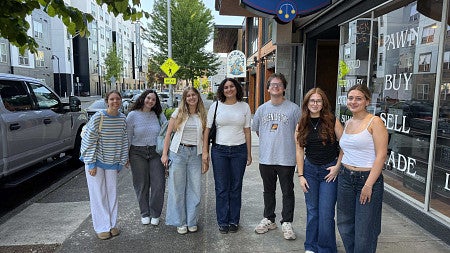
Through stakeholder interviews, surveys, and extensive research, students developed a comprehensive public relations campaign focused on increasing downtown visitation, particularly among University of Oregon students and local families. Their recommendations included social media storytelling that highlights local businesses and community members, campus outreach events, family-focused programming, safety awareness initiatives, and proactive media relations designed to showcase the positive experiences happening downtown every day.
For Public Relations graduating senior Shelby Helton, the project challenged assumptions she had formed before arriving in Eugene.
"I had been told downtown was unsafe, especially my freshman year, so I never really saw the point of going," she explained. "This project helped me realize there isn't as much crime as people assume."
As the project progressed, Helton intentionally spent more time downtown visiting local cafés, exploring thrift shops, and discovering Eugene's thriving arts community.
"I was blown away by how much arts and culture is happening downtown," she said. "People talk so much about TrackTown, but I didn't realize how many murals, sculptures, and local artists make downtown unique."
One of the recommendations she is most excited about is creating engaging social media content that tells the stories behind downtown businesses and the people who make the district vibrant.
"It was really rewarding to work with the Eugene Chamber of Commerce and Downtown Eugene Merchants because we were creating something that could make a difference in our own community," said Helton. "Coming from Kentucky, this project gave me the opportunity to connect with a place that now feels like home."
Reimagining Bicycle Transportation
In the Bicycle Transportation (PPPM 438) class, students explored how Eugene's transportation network could better support people traveling by bicycle.
Working in teams, students developed creative ideas to inspire updates to Eugene's Transportation System Plan (TSP). Their recommendations addressed five key themes: improving major corridors, neighborhood connectivity, policy, quiet streets, and increasing public awareness of the bicycle network.
The goal was simple: create a transportation system that is safe, connected, and comfortable for riders of all ages and abilities.
For graduate student Dylan McCarthy, working with the City of Eugene transformed classroom theory into practical experience.
"It was really valuable to have a practical application to orient our work," he said. "From researching literature to planning practices, we were grounded in real places and could understand our problems and solutions at the human scale."
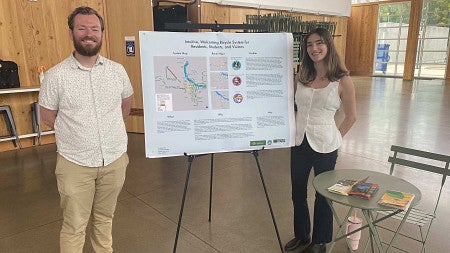
McCarthy hopes the students' work from the class helps expand the range of ideas being considered as Eugene continues investing in bicycle transportation.
"Our city transportation planning team is full of talented people, and we hope adding fresh perspectives from students can help continue the work of making Eugene one of the country's great bicycling communities."
He also valued the opportunity to collaborate across disciplines.
"I'm really proud of getting to work with thoughtful, bright students from different backgrounds. Our class work was based in research with the intent of making riding a bike in Eugene more intuitive, and it was exciting to see everyone's contributions come together."
Understanding How People Experience Public Space
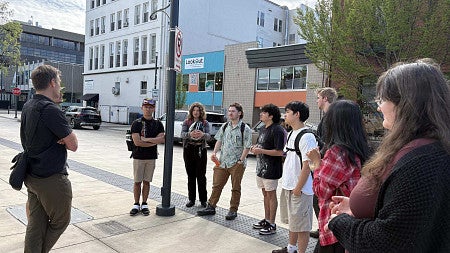
Students in the course Qualitative Methods for Public Decision Making (PPPM 410), shifted their focus from transportation to people by examining how residents and visitors experience the Farmers Market Pavilion and surrounding downtown public spaces.
Using interviews, observations, and qualitative research methods, students identified four themes that shape people's experiences: Being There, Getting There, Sharing There, and Unhoused.
Their findings explored accessibility, transportation connections, community interaction, inclusion, public services, age, daily routines, community identity, and perceptions of houselessness. Together, these insights can help provide the City of Eugene with valuable information to guide future planning and design decisions for downtown public spaces that support community wellbeing.
By listening directly to community members, students gained experience conducting research that extends beyond data collection, learning how to understand the lived experiences behind planning decisions.
Preparing Students While Supporting Communities
The partnership with the City of Eugene exemplifies what makes SCYP unique. Students don't simply study planning, communications, or public policy; they practice it alongside community partners working to solve real, day-to-day challenges.
While the City of Eugene benefits from the students’ research and recommendations, students gain career-connected experiences that help bridge the gap between academic learning and professional practice. By working on real projects with real stakeholders, students build the confidence, skills, and practical experience emphasized in the Oregon Rising strategic plan, preparing them to become leaders, problem-solvers, and engaged professionals in Oregon and beyond.
As these students leave the classroom and begin their careers, they also leave behind something meaningful: new ideas that can help create a more connected, welcoming, and vibrant downtown Eugene.